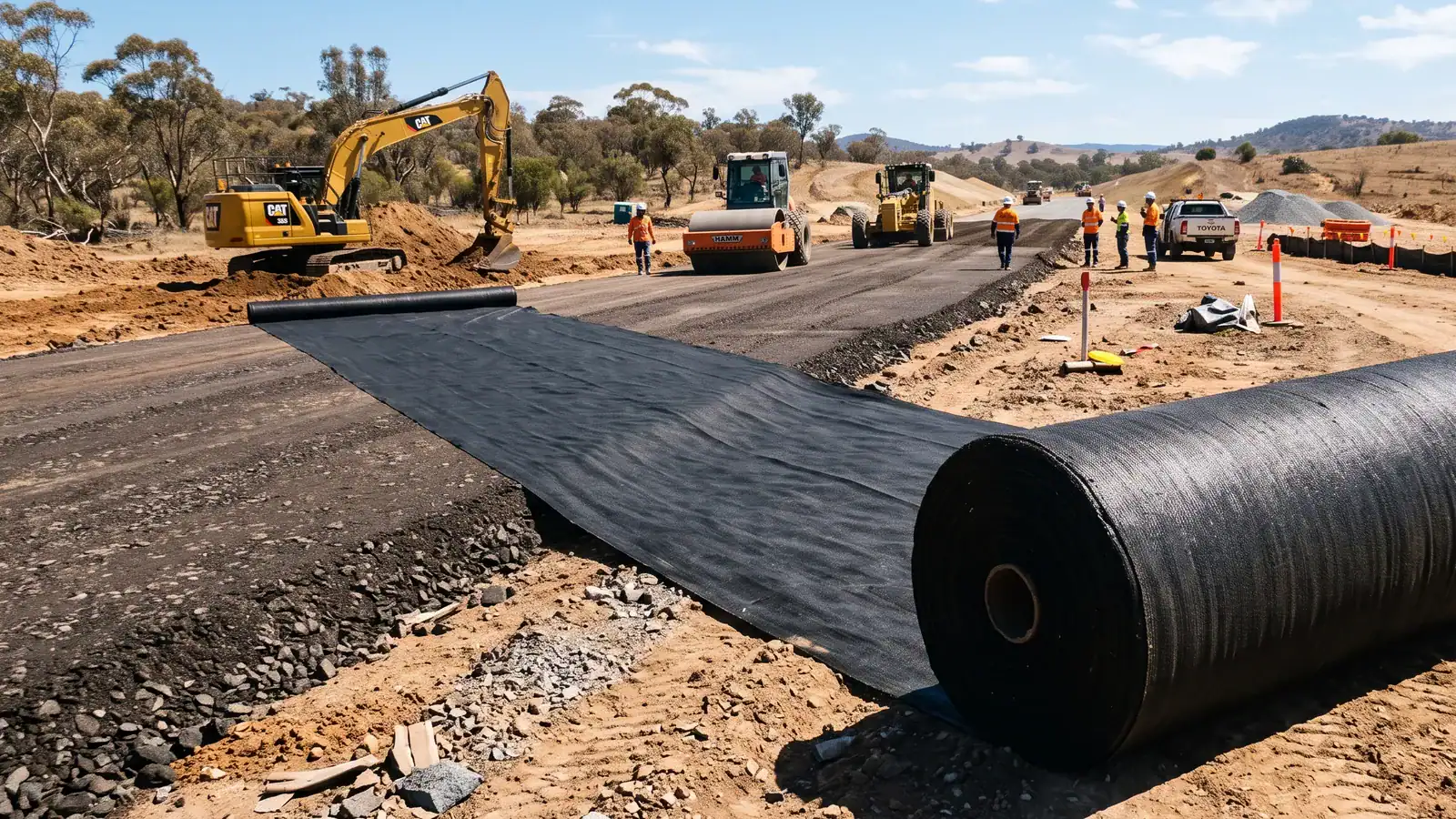
Woven geotextile fabric is a high-strength synthetic textile used to stabilise soil, separate aggregate layers and reinforce ground in construction and landscaping projects.
If you have ever watched a gravel driveway turn to mud after a few wet seasons, or seen fresh aggregate disappear into soft clay on a building pad, you already understand the problem woven geotextile solves. The fabric sits between soil layers, stops them mixing, and spreads load so the surface stays where you put it.
This guide covers what woven geotextile is made from, how it differs from non-woven fabric, where each type fits, and how to pick the right weight for your project. We will also walk through basic installation steps and the mistakes that catch people out on site.
Looking for woven geotextile and weed mat products? Browse the woven poly weed mat range at All Stake Supply, with delivery anywhere in Australia from their St Marys warehouse. Contact the team for trade pricing and project advice.
Woven geotextile fabric is manufactured by interlacing polypropylene or polyester yarns at right angles on industrial looms, similar to the way traditional textiles are made. The weaving process creates a flat, grid-like structure with distinct, measurable openings between the threads.
That structure gives woven geotextile two properties that matter on site. First, high tensile strength, meaning it can handle heavy loads without stretching or tearing. Second, low elongation, typically between 5% and 25%, so the fabric holds its shape under stress rather than sagging.
Woven geotextiles come in several yarn types, each suited to different conditions.
In Australia, geotextile fabrics are tested under AS 3706, which covers tensile strength, elongation, puncture resistance, and hydraulic properties. Specifying products tested to this standard means your project meets the requirements set by councils and engineers. The Australian Department of Climate Change, Energy, the Environment and Water also publishes guidelines on erosion and sediment control that reference geotextile use.
The most common question around geotextile is whether to use woven or non-woven. They are different products built for different jobs, and picking the wrong one will cost you time and money. If you want a deeper look at non-woven options, read our guide on what geotextile fabric is and how to use it.
| Property | Woven Geotextile | Non-Woven Geotextile |
|---|---|---|
| Tensile strength | High | Lower |
| Elongation | 5-25% | 50%+ |
| Water permeability | Low (blocks flow) | High (allows flow) |
| Flexibility | Stiff, holds shape | Soft, conforms to surfaces |
| UV resistance | Higher | Lower |
| Puncture resistance | Higher | Lower |
| Primary use | Separation, stabilisation, reinforcement | Drainage, filtration, erosion control |
| Typical cost | Higher | Lower |
The short version: woven for strength, non-woven for drainage. If you need to keep aggregate out of clay under a road, woven is the right pick. If you need water to pass through the fabric in a French drain or behind a retaining wall, non-woven is what you want.
The International Geosynthetics Society has a good technical breakdown of the engineering differences between the two types.
All Stake Supply carries both types. Their Black Woven Poly Weed Mat range handles separation and weed suppression, while the Filter Fabric Geotextile Non-Woven Drainage Membrane covers filtration and drainage work.
Woven geotextile turns up across civil, mining, and landscaping projects wherever the ground needs reinforcing or layers need keeping apart. Here are the applications where it earns its keep.
Woven fabric laid between a soft subgrade and the aggregate base course stops the two from mixing. Without it, aggregate gets pushed down into the clay over time, and clay pumps up through the surface when it rains.
The result is rutting, potholes, and wasted rock. On rural property access roads across Australia, this is one of the most common uses.
Construction sites use woven geotextile under concrete slabs, shed pads, and storage yards to distribute load evenly across weak soil. Research published by the Standards Australia testing framework shows woven geotextile can improve the load-carrying capacity of a base by roughly three times compared to an unreinforced section.
High-strength multifilament woven geotextile reinforces soil behind retaining walls and within engineered embankments. The low elongation means the fabric takes the load early, before the soil has a chance to shift.
Woven poly weed mat is a woven geotextile designed specifically for landscaping. The tight weave blocks sunlight and prevents weed growth while still allowing some air exchange at the soil surface.
It works well under gravel paths, around garden beds, and in commercial landscaping where long-term weed control matters. For installation tips, see our guide on how to install weed mat for lasting weed control.
If your project involves erosion on slopes or streambanks where water flow matters, a woven geotextile is usually not the right choice. Look at erosion control matting options or non-woven filter fabric instead.
Woven geotextile comes in a range of weights (measured in grams per square metre, or GSM) and tensile strength ratings. Picking the right one depends on the load, the soil conditions, and how long the installation needs to last.
| Project Type | Recommended Weight | Why |
|---|---|---|
| Garden bed weed control | 85-110 GSM | Light duty, needs UV stability more than raw strength |
| Gravel driveway on stable soil | 100-140 GSM | Moderate separation, occasional vehicle traffic |
| Access road on soft clay | 140-200 GSM | Higher tensile strength to handle repeated heavy loads |
| Building pad or hardstand | 200+ GSM | Maximum load distribution across weak subgrade |
| Embankment reinforcement | 200-400+ GSM (high-tenacity) | Structural reinforcement grade with engineered design |
For most residential and light commercial landscaping work, the Black Woven Poly Weed Mat at 110 GSM covers separation and weed suppression in one product. If your project involves heavier traffic or engineered fill, talk to the All Stake Supply team about higher-strength options.
Engineer-specified projects: If your project requires a specific geotextile grade (common on council, mining, and civil jobs), the specification will nominate minimum tensile strength, elongation, and permittivity values tested to AS 3706. Match the spec exactly. Do not substitute a lighter fabric to save money.
Getting the fabric in the ground correctly matters just as much as picking the right product. Poor installation creates weak spots that let aggregate through and undermine the whole point of using geotextile.
For pinning, steel fastening pins in 200mm x 35mm work well for most geotextile installations. On deeper or softer soils, step up to the 300mm x 50mm pins.
Most woven geotextile failures come down to one of these errors, all of them preventable.
The weed mat guide covers similar ground for landscaping-specific installations.
Woven geotextile is made by weaving polypropylene or polyester yarns into a grid-like fabric. It has high tensile strength and low water permeability, making it ideal for soil separation and stabilisation.
Non-woven geotextile is made by bonding fibres together with heat or needles. It is more permeable and flexible, so it suits drainage, filtration, and erosion control applications.
Generally, no. Woven geotextile has low permeability, so it restricts water flow rather than allowing it through. For drainage applications like French drains, ag pipe wrapping, and retaining wall backfill, use a non-woven filter fabric instead.
When buried and protected from UV light, woven polypropylene geotextile can last 50 years or more. UV resistance varies by product, but exposed fabric will degrade over months to a few years depending on the weight and UV stabiliser content.
For garden beds and light weed suppression, 85-110 GSM is enough. Gravel driveways on stable ground suit 100-140 GSM.
Access roads on soft clay or building pads need 140-200+ GSM. For structural reinforcement, follow the engineer's specification.
Yes, and it is one of the most common applications. Woven geotextile between the subgrade and the aggregate base keeps the layers separate, prevents rutting, and extends the life of the driveway surface significantly.
Woven weed mat is a type of woven geotextile, but not all woven geotextiles are weed mats. Weed mat is typically a lighter-weight woven polypropylene fabric designed for landscaping.
Heavier woven geotextiles are engineered for civil and structural applications where higher tensile strength is required. Browse the full product range at All Stake Supply to see options across both categories.