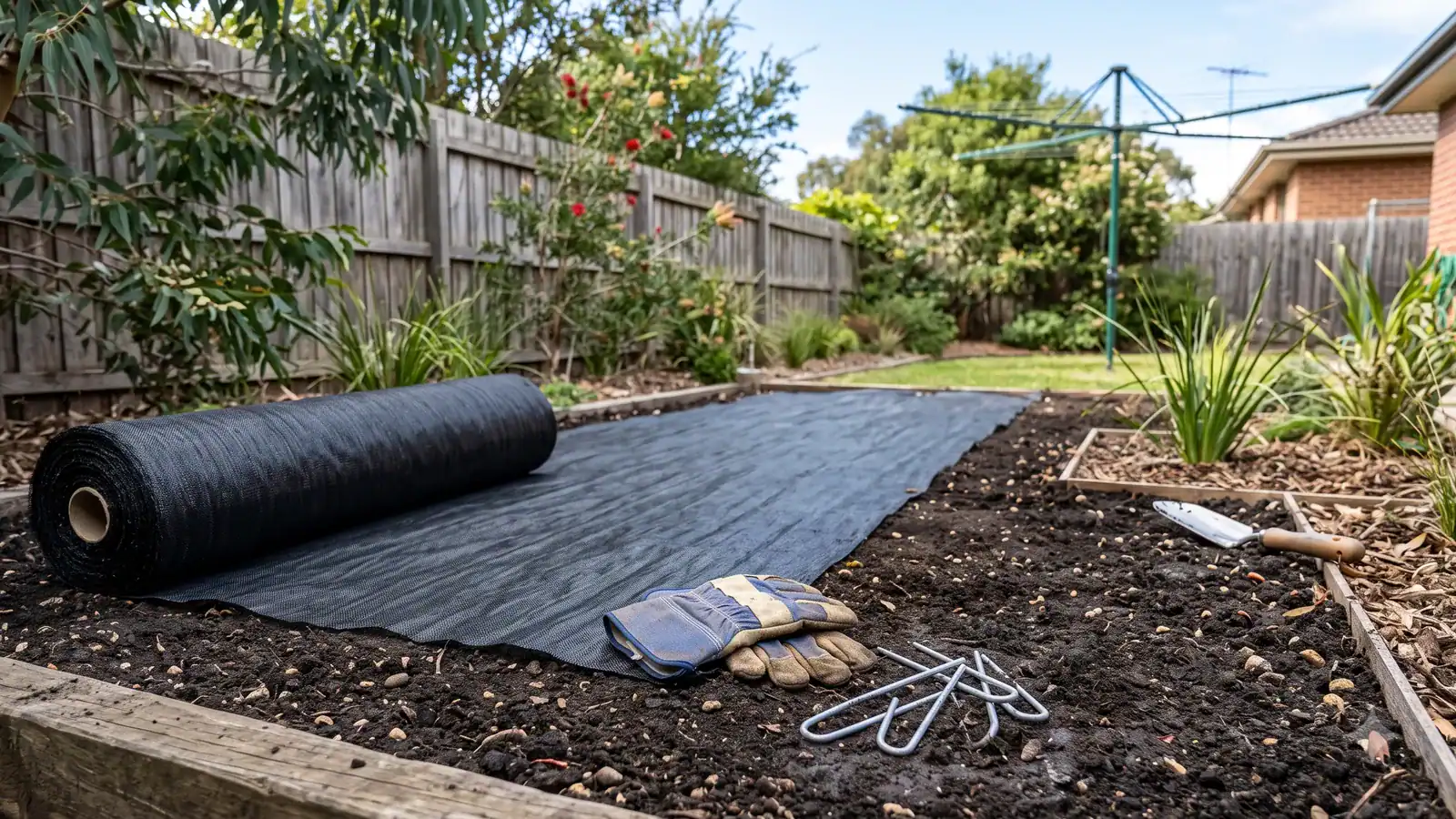
A geotextile membrane is a permeable fabric that separates, filters or reinforces soil layers in drainage, landscaping and civil projects.
If you have ever dug a drainage trench and watched gravel sink into clay within a season, you already know the problem. Fine particles migrate into aggregate, pipes clog, and the whole system fails. A geotextile membrane sits between those layers and stops that from happening.
This guide covers what geotextile membranes actually do, how to pick the right weight for your project, and how to install one properly. Whether you are a landscaper quoting a retaining wall or a council worker specifying erosion control, the same principles apply.
Related: Browse the full product range at All Stake Supply, or check out our guide to erosion control products for larger site stabilisation projects.
A geotextile membrane is a synthetic fabric, usually made from polypropylene or polyester, designed to let water pass through while holding soil particles in place. It sits between two different soil or aggregate layers and performs one or more of four core functions: separation, filtration, drainage and reinforcement. In a typical French drain, for example, the membrane wraps around the gravel bed and stops surrounding clay or silt from working its way into the aggregate and blocking the pipe. Without it, most subsurface drainage systems in reactive Australian soils will lose effectiveness within two to five years.
The four functions break down like this:
Most landscaping and residential drainage jobs rely on the first two functions. All Stake Supply stocks non-woven geotextile drainage membrane rolls in multiple widths, ready to ship from the St Marys NSW warehouse.
This is the first decision you need to make, and getting it wrong means the membrane will not do what you need. Woven geotextile is made from interlocking threads in a grid pattern. It is strong under tension but has a lower water flow rate. Non-woven geotextile is needle-punched or heat-bonded into a felt-like sheet. It lets water through faster and filters finer particles.
| Feature | Woven | Non-Woven |
|---|---|---|
| Structure | Interlocking grid of threads | Needle-punched or bonded fibres |
| Tensile strength | Higher | Lower |
| Water flow rate | Lower | Higher |
| Filtration | Basic | Superior fine-particle filtration |
| Best for | Load-bearing, road base, retaining walls | Drainage, French drains, garden beds |
| Typical use | Under driveways, car parks, embankments | Around ag pipe, under gravel, behind retaining walls |
For most drainage and landscaping work, non-woven is the right pick. It filters fine clay particles out of your drainage aggregate, which is exactly what you need in the heavy clay soils common across western Sydney, Melbourne and Adelaide. Woven is the better option when you need the membrane to carry load, like under a gravel driveway or access road.
GSM stands for grams per square metre. It tells you how heavy and thick the fabric is. Heavier GSM means more durability and better puncture resistance, but it also costs more and can be overkill for light jobs. Picking the right weight saves money without sacrificing performance.
Rule of thumb: If machinery will drive over the membrane or heavy aggregate will be dumped directly onto it, go 140 gsm or above. For hand-placed gravel and residential drainage, 100 gsm does the job.
All Stake Supply carries 100 gsm non-woven rolls in widths from 0.6 m to 4 m. For narrow trenches, the 0.6 m roll avoids waste. For broad drainage fields, the 4 m roll covers ground quickly.
The short answer is anywhere two different materials meet underground and you do not want them mixing. But some applications are more common than others in Australian residential and commercial work.
For erosion-prone sites, geotextile membranes pair well with coir logs and jute matting to hold soil in place while revegetation takes hold. The membrane handles subsurface drainage while surface treatments manage runoff.
Installation is straightforward, but a few details make the difference between a system that works for decades and one that fails in a couple of years. Here is the process for a standard drainage application.
The Australian Department of the Environment recommends geotextile-lined drainage as a best-practice approach for managing stormwater on construction and development sites.
Most geotextile membrane failures come down to installation shortcuts, not product defects. These are the ones we see landscapers and DIYers trip over repeatedly.
Quick check: If you can see your geotextile membrane exposed to sunlight a month after installation, something went wrong. UV degradation starts quickly and will halve the fabric's strength within a year of continuous exposure.
When properly buried under soil or aggregate, a quality geotextile membrane will last well over 50 years. The fabric does not rot, and soil microbes leave polypropylene alone. The only real threat is UV exposure, which is why burial is not optional.
Australian conditions test materials harder than most. High UV index across much of the country, reactive clay soils that swell and shrink seasonally, and intense rainfall events in coastal QLD and NSW all put pressure on below-ground systems. A properly installed geotextile membrane handles all of this without issue.
Products tested to the AS 3706 series (the Australian standard for geotextile testing) must retain at least 50% of their tensile strength after 500 hours of UV exposure. That standard covers everything from tensile testing to water flow rate and puncture resistance.
Picking a geotextile membrane is not complicated once you match the type (woven or non-woven) and weight (GSM) to your specific application. For most Australian drainage and landscaping projects, a 100 gsm non-woven membrane will do exactly what you need.
All Stake Supply has been stocking geotextile membranes, fastening pins and erosion control products from their St Marys NSW warehouse since 1976. Browse the full product range, or contact the team for trade pricing and bulk orders.