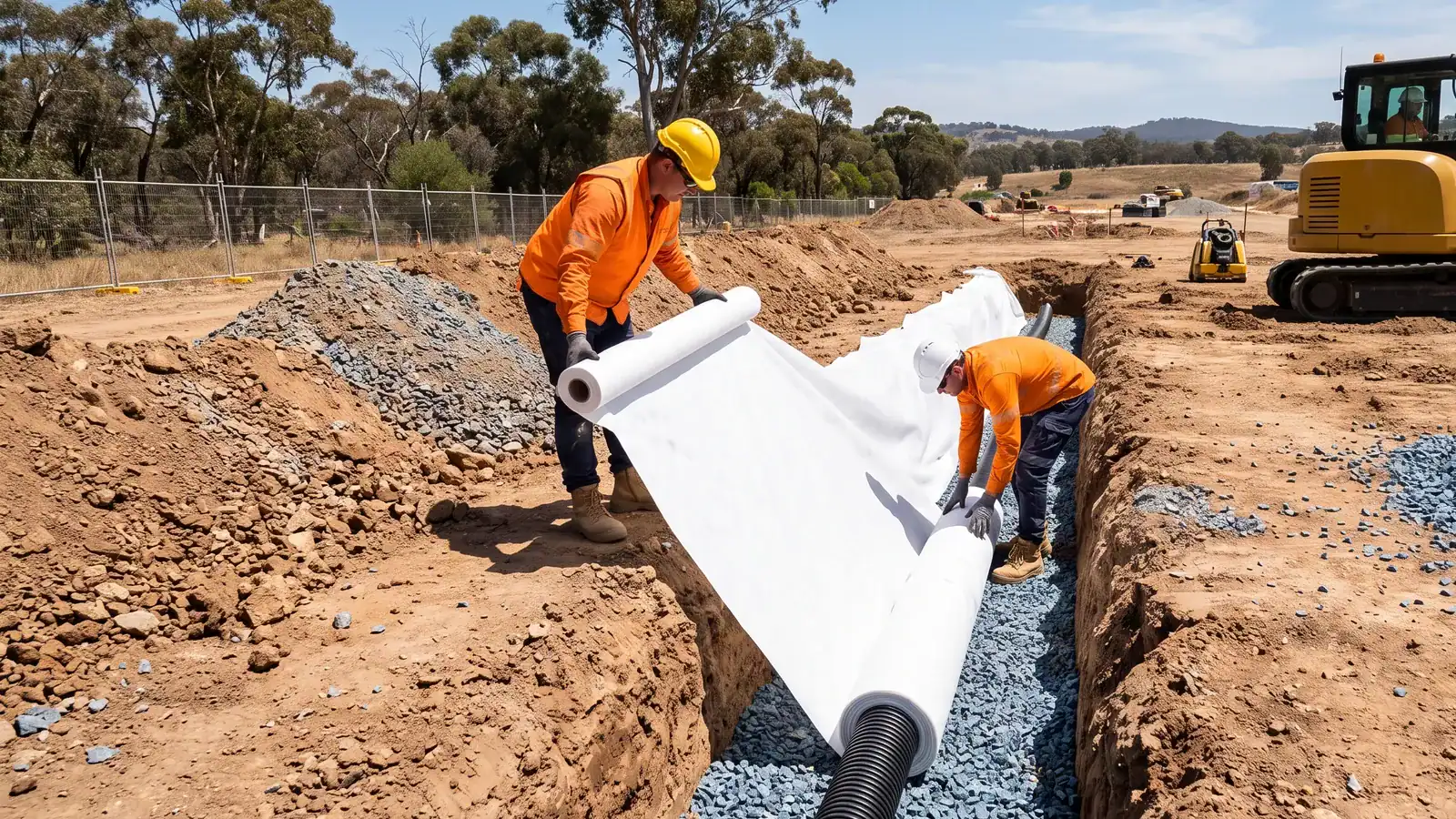
Geotextile filter fabric lets water pass through while holding soil particles back, which is exactly why every drainage system needs it.
Without a proper separation layer between your aggregate and the surrounding soil, fine particles migrate into gravel beds and perforated pipes. That process, called soil piping, clogs drainage systems within a few years. Fixing a blocked French drain or retaining wall weep system after backfill is expensive and disruptive.
This guide covers where geotextile filter fabric belongs on site, how to install it correctly for the most common drainage applications, and which roll sizes suit different jobs. We will also flag the mistakes that cause premature failure.
Related reading: Already know the basics? Browse the erosion control range at All Stake Supply, or check out our guide on what geotextile fabric is and how to use it.
Geotextile filter fabric is a non-woven synthetic membrane designed for one job: letting water through while blocking soil fines. The random fibre structure creates thousands of tiny pore openings that act as a mechanical filter.
Water flows freely, but silt, clay particles and organic matter stay on the soil side. This keeps your drainage aggregate clean and your perforated pipes clear for decades rather than years.
The "non-woven" part matters. Woven geotextiles are built for tensile strength and soil stabilisation. Non-woven geotextiles are built for filtration, as outlined in Australian Government environmental guidelines.
A 100gsm non-woven drainage membrane is the standard weight for most residential and light civil drainage work in Australia.
On a well-built French drain, the geotextile filter fabric is the difference between a system that works for 25 years and one that backs up after three wet seasons.
Geotextile filter fabric belongs in any situation where water needs to move through aggregate while staying separated from the surrounding soil. The most common applications across Australian residential and civil projects fall into a few clear categories. If your project involves drainage stone, a perforated pipe, or a gravel blanket against retained earth, filter fabric should be part of the build.
For larger civil projects like subdivision drainage, stormwater detention basins and council infrastructure, the same principles apply at a bigger scale. The Standards Australia framework covers geotextile specification for civil works. Filter fabric rolls in 4m x 100m keep material costs down on those jobs.
A French drain without filter fabric is a French drain with a countdown timer. The installation method is straightforward, but getting the overlap and wrapping sequence right is what separates a drain that lasts from one that silts up. Here is the step-by-step process that landscapers and plumbers across NSW follow.
Tip: Use a socked ag pipe AND wrap the entire trench in filter fabric. The sock catches fine particles at the pipe, and the outer fabric stops the bulk of the soil reaching the aggregate. Double protection beats single every time.
The overlap at the top is the step most DIYers skip. If you leave the gravel exposed to topsoil without folding the fabric over, soil will wash down through the gravel during every heavy rain. Within two seasons, your drain is half-blocked.
Hydrostatic pressure is what pushes retaining walls over. When water builds up behind a wall with no drainage path, that pressure increases with every rainfall event.
Geotextile filter fabric is the barrier between retained soil and the gravel drainage blanket that stops this pressure building. Without it, soil gradually fills the voids in your drainage gravel and the entire system fails.
Standard practice for timber, concrete block, and segmental retaining walls in Australia is to install a gravel drainage zone at least 300mm wide behind the wall face. The CSIRO has published research on soil-structure interaction that supports this approach. A 2m x 50m filter fabric roll is the go-to size for most residential retaining wall jobs.
| Component | Purpose | Typical Spec |
|---|---|---|
| Geotextile filter fabric | Separates soil from drainage gravel | 100gsm non-woven |
| Drainage gravel blanket | Creates water flow path behind wall | 20mm aggregate, 300mm min width |
| Ag pipe at base | Collects water at footing level | 100mm perforated PVC, socked |
| Weep holes or outlet | Releases water away from wall base | Every 1.5-2m along wall face |
Pin the filter fabric to the excavation face before placing gravel. Make sure it runs from the base of the wall footing up to at least 50mm below finished ground level. Steel fastening pins hold the fabric in place while you backfill.
Most drainage failures are not engineering problems. They are installation shortcuts.
After 48 years of supplying drainage products to Australian tradies and councils, the team at All Stake Supply has seen the same mistakes on repeat. Here are the ones that cause the most callbacks.
Every one of these problems is avoidable with the right materials and a few extra minutes on site. The cost difference between doing it right and doing it over is significant.
All Stake Supply stocks geotextile filter fabric in four roll widths, all at 100gsm. The right choice depends on your trench width, wall height, or coverage area. Buying a roll that matches your job dimensions reduces waste and means fewer joins on site.
| Roll Size | Best For | Coverage |
|---|---|---|
| 0.6m x 50m | Narrow French drains, pipe wrapping | 30m² |
| 1m x 50m | Standard French drains, garden drainage | 50m² |
| 2m x 50m | Retaining walls, deeper trenches, sub-base work | 100m² |
| 4m x 100m | Civil projects, large-area separation, bulk jobs | 400m² |
For jobs where you need to wrap ag pipe before it goes into the trench, the geotextile filter tube in 150mm x 50m rolls saves time. The tube slides straight over 100mm pipe with no cutting or wrapping needed. All Stake Supply ships from their St Marys NSW warehouse with guaranteed complete delivery, so your order arrives in one shipment rather than trickling in from multiple suppliers.
Trade orders: Landscapers and civil contractors ordering in bulk can contact the All Stake Supply team for trade pricing. With 1,000+ products in stock, you can add erosion control blankets, fastening pins, and ag pipe to the same order.
This is the most common mix-up on residential drainage projects. Both products look like black fabric on a roll, and both go in the ground. But they are engineered for completely different jobs.
Geotextile filter fabric is designed to allow high water flow rates while filtering particles. Weed mat is designed to block light and suppress growth, with water permeability as a secondary consideration.
| Feature | Geotextile Filter Fabric | Weed Mat |
|---|---|---|
| Primary purpose | Drainage filtration and soil separation | Weed suppression |
| Water flow rate | High (designed for drainage) | Low to moderate |
| Pore structure | Engineered for soil particle retention | Designed to block light, not filter soil |
| Typical weight | 100gsm non-woven | 70-90gsm woven or non-woven |
| Use in drainage | Yes, this is what it is built for | No. Restricts flow and clogs faster |
| Use in garden beds | Overkill for weed control alone | Yes, purpose-built |
If you are building a French drain, wrapping ag pipe, or lining a retaining wall drainage zone, use geotextile filter fabric. If you are suppressing weeds in a garden bed or under mulch, use weed mat. Using the wrong one costs you a dig-up and reinstall.
Geotextile filter fabric is a low-cost product that prevents high-cost drainage failures. Whether you are installing a backyard French drain or specifying materials for a council stormwater project, getting the filtration layer right protects everything downstream of it.
Browse the full product range at All Stake Supply or contact the team for trade pricing and bulk orders. Family-owned since 1976, with guaranteed complete delivery from their St Marys NSW warehouse to anywhere in Australia.