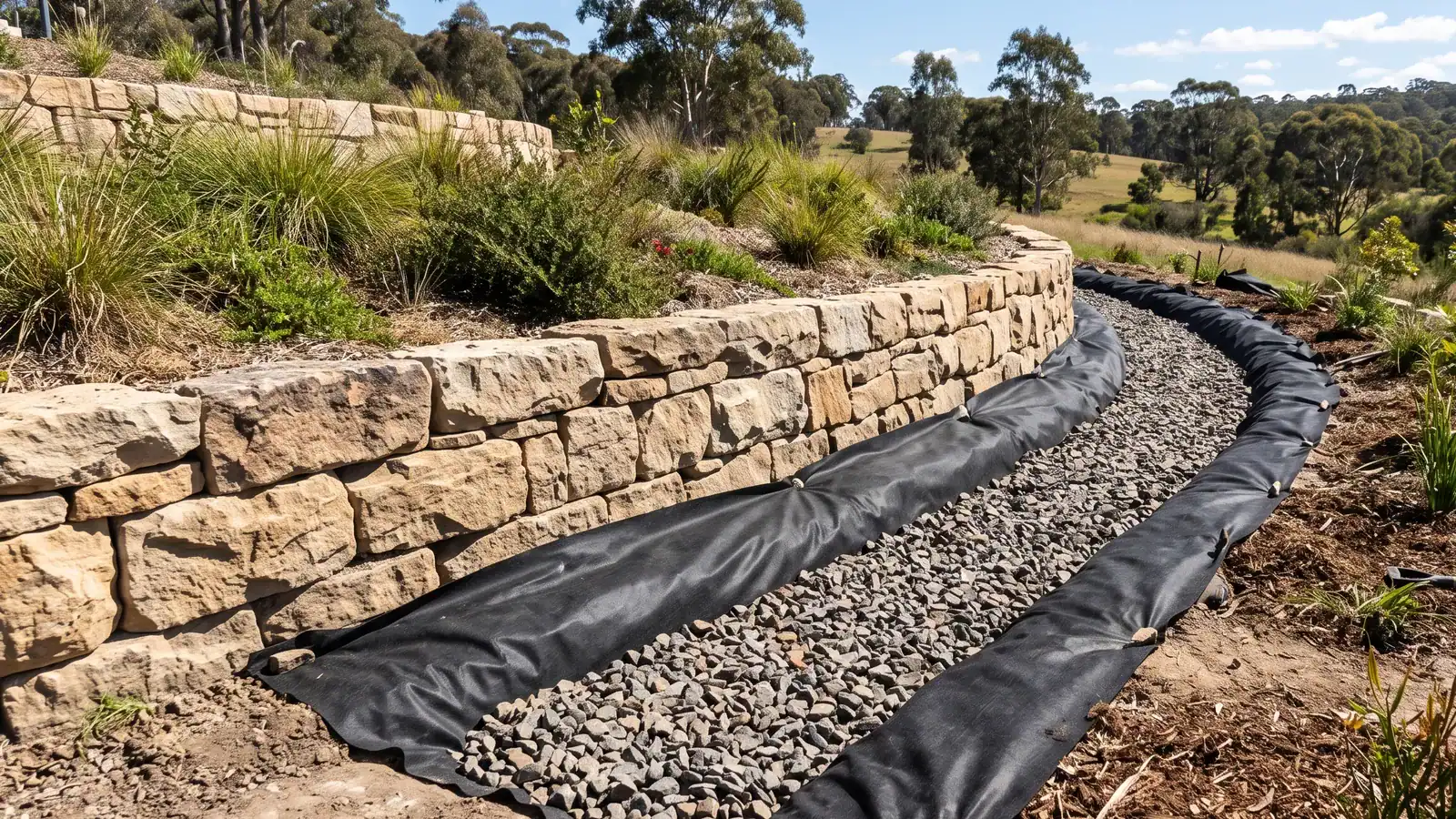
Geotextile drainage fabric is the layer between your aggregate and the surrounding soil that stops sediment from destroying drainage systems.
Every French drain, retaining wall drain and subsoil pipe system relies on clean aggregate to move water. Without a geotextile filter layer, fine soil particles migrate into the gravel bed and block flow. Most failed drainage jobs trace back to missing or wrong fabric.
This guide covers how to pick the right type and weight of geotextile drainage fabric, where to use it, how to install it properly, and the mistakes that cause premature failure.
Need geotextile drainage fabric now? Browse the erosion control range at All Stake Supply or check out the non-woven drainage membrane rolls available in multiple widths.
Geotextile drainage fabric is a permeable synthetic textile made from polypropylene or polyester fibres. The fibres are needle-punched together (not woven), which creates thousands of tiny pores that let water pass through while trapping soil particles. It acts as a filter between your drainage aggregate and the surrounding earth.
Without this separation layer, soil migrates into the gravel over time. The aggregate fills with sediment, water flow drops, and within 12 to 18 months a perfectly good drainage trench becomes a clay-packed channel that does nothing.
All Stake Supply stocks non-woven drainage membrane rolls in widths from 0.6 m to 4 m, all at 100 gsm, which suits the majority of residential and light commercial drainage work.
This is where most mistakes start. Woven and non-woven geotextiles look similar on the roll but behave completely differently in a drainage application.
Non-woven fabric is the only correct choice for drainage. Woven geotextile has high tensile strength but very low permeability, which means it blocks water instead of filtering it.
| Property | Non-Woven (Drainage) | Woven (Separation) |
|---|---|---|
| Water permeability | High | Low |
| Filtration | Excellent | Poor |
| Tensile strength | Moderate | High |
| Primary use | French drains, subsoil drainage, retaining walls | Road stabilisation, embankments |
| Drainage suitability | Yes | No |
Do not substitute weed mat for geotextile. Weed mat is designed to block root growth, not filter water. Using it around drainage pipe will restrict flow and cause the system to back up.
If your supplier offers both, ask specifically for non-woven geotextile filter fabric. All Stake Supply's 4 m x 100 m drainage membrane roll is the go-to for larger commercial and civil drainage projects.
In Australia, geotextile weight is measured in grams per square metre (gsm). Heavier fabric filters finer particles but passes water more slowly. The trick is matching gsm to your soil type.
Sandy soils drain easily and only need light filtration. Heavy clay soils carry very fine particles that demand a denser fabric.
| GSM Range | Best For | Soil Type |
|---|---|---|
| 80-120 gsm | Garden drainage, raised beds, sandy soils | Sand, sandy loam |
| 100-150 gsm | French drains, retaining walls, residential subsoil drainage | Loam, sandy clay |
| 150-200 gsm | Heavy clay soils, fine silt filtration | Clay, silty clay |
| 200+ gsm | Civil works, retention basins, road subgrades | All soil types under load |
All Stake Supply's 2 m x 50 m rolls at 100 gsm cover the sweet spot for residential and garden drainage work. For tighter access areas, the 0.6 m wide rolls fit standard 300 mm trench work without excess trimming.
Geotextile drainage fabric belongs anywhere you are placing aggregate around pipe or using gravel as a drainage medium. Skipping it saves ten minutes on install and costs you thousands in remediation when the system silts up. Here are the most common applications.
Line the entire trench with non-woven geotextile before adding gravel and slotted ag pipe. Leave enough fabric on each side to fold over the top of the aggregate once the pipe is in place. Pair it with 100 mm socked ag pipe for double filtration.
Place geotextile between the retained soil and the gravel drainage zone behind the wall. This stops soil washing through the weep holes and staining the wall face. Run the fabric from the footing to the top of the backfill.
A geotextile layer between the subgrade and the road base prevents the base course from punching into soft soil. It also allows groundwater to drain away instead of pooling under the pavement and causing heave. The Australian Department of the Environment references geotextile separation layers in several erosion and sediment control guidelines for construction sites.
Proper installation is the difference between a drainage system that lasts decades and one that fails within two years. The steps below apply to a standard French drain or subsoil drainage trench.
Use steel fastening pins to hold the geotextile in place along the trench walls during backfilling. Pin every 200 to 300 mm on slopes to stop the fabric slipping before the gravel goes in.
Drainage remediation is expensive. Digging up a failed French drain, removing contaminated gravel and re-laying the system costs far more than the original install. Research from CSIRO on soil-fabric interaction confirms that incorrect geotextile selection is one of the leading causes of subsurface drainage failure in Australian conditions.
Quick test: if you can blow air through the fabric easily, it is non-woven and suitable for drainage. If air barely passes through, it is woven or a weed barrier and should not be used around drainage pipe.
Landscapers, civil contractors and councils running multiple drainage jobs need reliable supply without waiting on backorders. All Stake Supply has been a family-owned Australian business since 1976, with 1,000+ products in stock at the St Marys NSW warehouse. Every order ships complete, so you are not left on site waiting for a partial delivery to catch up.
Browse the full product range or contact the team for trade pricing and bulk orders.
Picking the correct geotextile drainage fabric takes five minutes. Fixing a silted-up drainage trench takes days. Go with non-woven, match the gsm to your soil type, overlap your joins by at least 300 mm, and wrap the entire aggregate envelope.
All Stake Supply stocks non-woven drainage membrane rolls in every width you will need, along with ag pipe, fastening pins and filter tubes. One order, complete delivery, no waiting around on site.