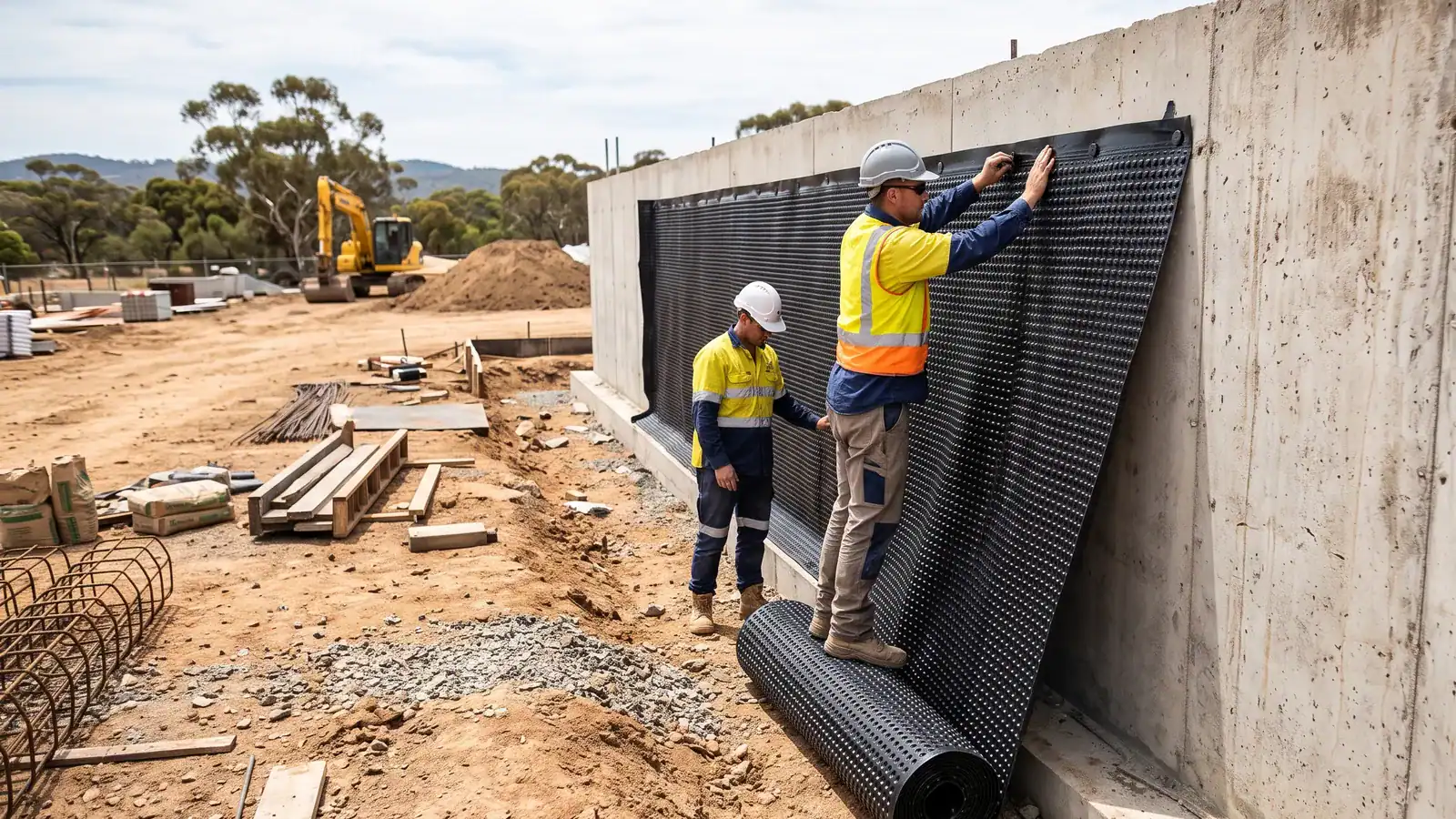
A drainage membrane sits behind retaining walls, beneath garden beds, and under paved surfaces to channel water away from structures. It filters groundwater through while blocking soil particles that would otherwise clog your ag pipe and gravel. Get the membrane right and the drainage system works for decades. Get it wrong and you end up with waterlogging, hydrostatic pressure, and structural damage.
This guide covers the main types of drainage membrane used in Australia, how to pick the right one for your project, and the installation steps that matter most.
Every sub-surface drainage system has two jobs: move water and keep soil out. A drainage membrane handles the second job. It sits between the soil and the drainage layer (gravel, ag pipe, or drainage cell) and acts as a filter.
Without a membrane, fine particles clog your drainage gravel within a few years. Water backs up, hydrostatic pressure builds against the structure, and retaining walls crack or lean. The Australian Department of the Environment identifies poor drainage as a leading cause of soil erosion and sediment runoff on disturbed sites.
The workhorse for most landscaping and civil drainage. Non-woven geotextile is needle-punched from polypropylene fibres, creating a fabric that filters water while trapping particles as small as fine sand. It wraps around ag pipe, lines drainage trenches, and separates gravel from soil behind retaining walls.
All Stake Supply stocks filter fabric drainage membrane in rolls from 0.60m x 50m up to 4m x 100m, all at 100gsm.
A moulded HDPE sheet with raised studs that create an air gap against a wall surface. Water runs down the channels and drains to the base. Used mainly on basement walls and below-ground structures where you need drainage plus physical protection over the waterproofing layer.
Lightweight interlocking HDPE panels (20mm to 50mm deep) that replace traditional gravel drainage layers. A 30mm drainage cell weighs roughly 98% less than the equivalent depth of gravel. They are the standard choice for green roofs, podium decks, and planter boxes where load is a constraint.
Stronger under tension than non-woven, but has larger pore openings. It is a separation and reinforcement fabric for under roads and driveways, not a filtration membrane. Do not use woven geotextile as a drainage filter.
Need help choosing? Contact All Stake Supply for advice on the right membrane for your project. We have been helping landscapers and builders since 1976 and can recommend the right product based on your soil type, project scale, and drainage requirements.
| Project Type | Recommended Membrane | Why |
|---|---|---|
| Retaining wall | Non-woven geotextile (100gsm+) | Wraps ag pipe and lines gravel backfill to prevent silt migration |
| Garden drainage | Non-woven geotextile | Lines drainage trenches and separates topsoil from gravel |
| Green roof / podium | Drainage cell + geotextile | Lightweight drainage; geotextile on top as filter |
| Basement wall | Dimple board + geotextile | Air gap drains water; geotextile blocks soil entry |
| Under pavers | Woven geotextile | Prevents aggregate mixing into subgrade under traffic loads |
For most residential work, a 1m x 50m roll of non-woven filter fabric paired with 100mm socked ag pipe covers the job. The sock on the ag pipe is a geotextile sleeve, giving you double filtration.
Poor drainage is the number one reason retaining walls fail. Water builds behind the wall, hydrostatic pressure rises, and the wall leans, cracks, or collapses.
In most NSW councils, retaining walls over 600mm high need development approval. Walls near boundaries or above other structures may need engineering certification regardless of height.
Polypropylene geotextile resists UV (when buried), biological breakdown, and most soil chemicals. A properly installed membrane lasts the life of the wall. The membrane is never the weak link; the installation is.
A sheet material that lets water pass through while blocking soil particles. It prevents silt from clogging drainage systems like ag pipe, gravel beds, and drainage cells. Non-woven geotextile filter fabric is the most common type used in Australian landscaping and construction.
Geotextile is one type of drainage membrane. The broader term also covers dimple boards, drainage cells, and sheet membranes. In a landscape supply context, 'drainage membrane' almost always means non-woven geotextile filter fabric.
Yes. Without a membrane and proper drainage, water builds behind the wall and creates hydrostatic pressure that causes leaning, cracking, or collapse. Non-woven geotextile wrapped around gravel and ag pipe is the standard approach.
100gsm non-woven geotextile handles most residential and light commercial drainage, including retaining walls, garden drainage, and French drains. Heavier weights (200gsm+) are specified for civil projects with higher flow rates or coarser backfill. Projects governed by Australian Standards AS 4654.2 for waterproofing may specify exact membrane classes.
Buried non-woven polypropylene geotextile lasts 50 years or more. It resists biological degradation, most soil chemicals, and root penetration. Exposed geotextile degrades under UV, so any above-ground membrane should be covered or replaced with a UV-stabilised product.
Non-woven geotextile is needle-punched from random fibres and works as a filter. Woven geotextile is made from interlaced yarns and is stronger under tension, but has larger pore openings that let fine particles through. Use non-woven for drainage filtration and woven for separation under roads.
All Stake Supply is a family-owned supplier of environmental terrain solutions since 1976. We stock non-woven geotextile, ag pipe, filter tubes, and porous paving at our St Marys NSW warehouse, with over 1,000 products available for pickup or delivery Australia-wide.